



Inside almost every enterprise in 2026, a quiet coordination crisis is forming. AI agents are being deployed by individual teams, into individual systems, with no coordination logic between them. Marketing deploys an agent to qualify leads. Sales deploys an agent to update deal stages. Customer success deploys an agent to detect churn signals. Each works in isolation. None talks to the others. And the data they read from and write to is the same revenue stack. Without a RevOps orchestration layer to coordinate them, the agents step on each other, duplicate records, trigger conflicting workflows, and produce insights nobody acts on. The question every revenue leader needs to answer in 2026 is who owns the orchestration layer. The answer, increasingly, is RevOps. For RevOps basics, start here.
What is the RevOps orchestration layer?
The RevOps orchestration layer is the architectural function that coordinates how AI agents read from, write to, and hand off across every revenue-relevant system in the enterprise. It is the layer that decides which agent owns which step, how data flows between them, how governance applies at runtime, and how humans stay in the loop where the stakes warrant it.
The orchestration layer is not a tool. It is not a single platform. It is a designed function within the RevOps operating model that sits between the data layer where signals are captured and the action layer where agents execute. RevOps becomes the orchestration layer, defining which agents own which processes, how data flows between them, and what governance ensures quality. This is not a tools question. It is a systems architecture question, and RevOps is the only function with visibility across the entire revenue process to answer it. Databar
Without an explicit orchestration layer, AI agents operate as a federation of independent actors, each making decisions in isolation. With one, the agents operate as a coordinated system, and the compounding effects start showing up in the numbers RevOps actually owns.
Why is RevOps the natural owner of enterprise AI?
RevOps is the natural owner of enterprise AI because AI agents that touch revenue are RevOps assets dressed in a tooling layer. They read from the CRM. They write to the CRM. They trigger workflows that affect quota attainment. They make decisions that show up in the forecast. None of those are IT functions. All of those are RevOps functions.
The shift in ownership is already underway. CIOs are pushing AI agent governance back to RevOps because the failure modes they are seeing in production are revenue-data failures, not infrastructure failures. The agent that mis-routes a lead is not a cloud problem. It is a routing logic problem. The agent that breaks an attribution chain is not an API problem. It is a system-of-record problem. The agent that triggers a duplicate workflow is not a security problem. It is an orchestration problem. Every one of those problems is RevOps domain.
The most successful enterprise AI rollouts in 2026 are being led by VPs of Revenue Operations, not by Chief AI Officers. The agent is a RevOps asset. It always was. The category is now catching up to that reality.
What is the AI agent sprawl crisis?
The AI agent sprawl crisis is the explosion in unmanaged AI agents being deployed across enterprise environments without coordination, governance, or ownership. From January 2025 to January 2026, the number of AI agents deployed in enterprise environments grew by more than 300x. The average organization now has more than 800 risky agents in operation that do not authenticate through SSO, do not appear in Active Directory, and do not stay confined to the corporate network. Security Boulevard
This is not a security framing of the problem, though security is part of it. The deeper issue is operational. Most of these agents were deployed by a single team for a single use case, without informing security, compliance, or RevOps. The agents do their narrow job in isolation. Then a second agent gets deployed by a second team for a second use case. Then a third. By the time anyone audits the environment, dozens or hundreds of agents are operating against the same revenue stack with no coordination logic between them.
The result is the failure mode the research community has been describing all year. Without coordination, AI agents step on each other, create duplicate records, trigger conflicting workflows, and generate insights nobody acts on. Agent sprawl is the 2026 successor to SaaS sprawl. The difference is that bad SaaS sprawl wastes budget. Bad agent sprawl corrupts revenue data. Databar
How is RevOps changing in the AI era?
RevOps in the AI era is shifting from a process and tooling function to a systems architecture function. The traditional RevOps mandate was alignment: aligning sales, marketing, and customer success behind common processes, tools, and metrics. That mandate has not gone away. It has been expanded.
RevOps is increasingly responsible for AI orchestration: defining the data standards, integration logic, and decision-making rules that govern how AI agents across the stack behave. This is a new kind of responsibility, and it is elevating the strategic importance of the function significantly. The RevOps leader is no longer the operational coordinator of human teams running revenue processes. The RevOps leader is now the architect of the agent layer that touches every revenue process at machine speed. RevOps Tools
This shift is visible in how RevOps roles are being scoped at the executive level. The job description for a VP of Revenue Operations in 2026 routinely includes agent governance, AI orchestration, and cross-functional AI coordination. None of these were standard a year ago. All of them are now.
Why are CIOs handing AI governance to RevOps?
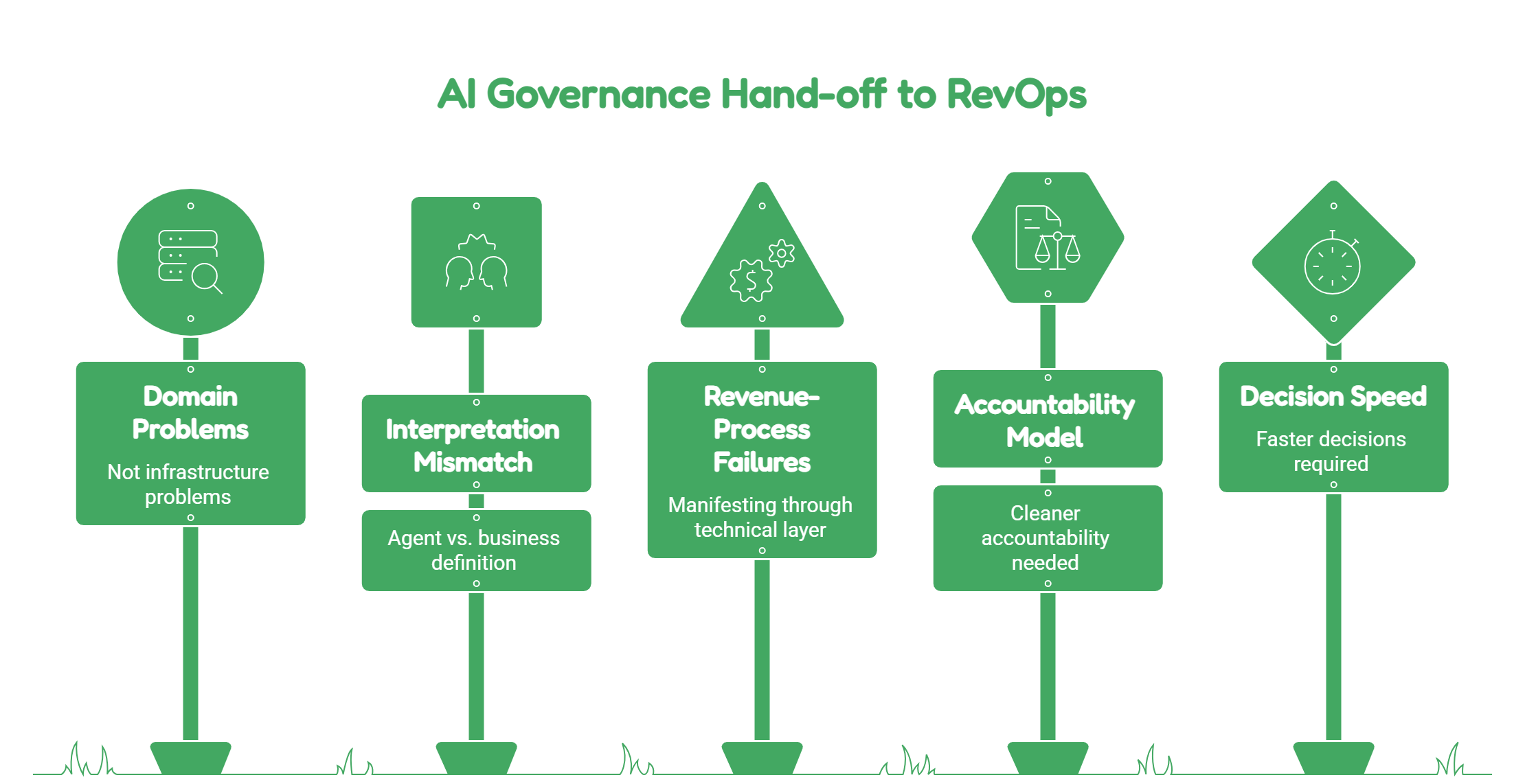
CIOs are handing AI governance to RevOps because the failure modes of revenue-facing AI are domain problems, not infrastructure problems, and the function with the domain knowledge to fix them is RevOps. The CIO can secure the access layer, enforce SSO, and audit the network traffic. The CIO cannot decide whether the agent’s interpretation of “qualified lead” matches the business definition that sales actually operates on.
That distinction is the entire reason the ownership question has migrated. AI agents that hallucinate firmographics, misroute leads, or produce confidently wrong forecasts are not technical failures. They are revenue-process failures, manifesting through a technical layer. The fix lives where the process knowledge lives, which is RevOps.
The smartest CIOs in 2026 are formalizing this hand-off. They retain the security perimeter, the identity layer, and the infrastructure governance. They cede the revenue-facing orchestration and process governance to RevOps, where it belongs. The result is a cleaner accountability model and faster decisions in both directions.
What does RevOps AI orchestration look like in practice?
RevOps AI orchestration in practice looks like a documented coordination model that defines, for every agent in the revenue stack, what data it reads from, what it writes to, which other agents it hands off to, what governance applies to its actions, and what feedback signal closes the loop on its decisions. This is not a hypothetical. It is the operating model the enterprises hitting AI ROI in 2026 have already implemented.
Concretely, the model includes four artifacts. First, an agent registry that catalogs every agent operating against the revenue stack, with its owner, its scope, and its access permissions. Second, a hand-off matrix that documents which agent owns which step of every revenue process, and where the boundaries between agents are. Third, a governance layer that enforces role-based access, audit logging, and approval gates at runtime. Fourth, a feedback infrastructure that captures outcomes and routes them back to the agents whose decisions produced them.
The enterprises that have these four artifacts in place are running coordinated agent systems. The enterprises that do not are running agent sprawl with a different name. The gap is closing every quarter, and the cost of closing it later is significantly higher than closing it now.
How do you build a RevOps orchestration layer?
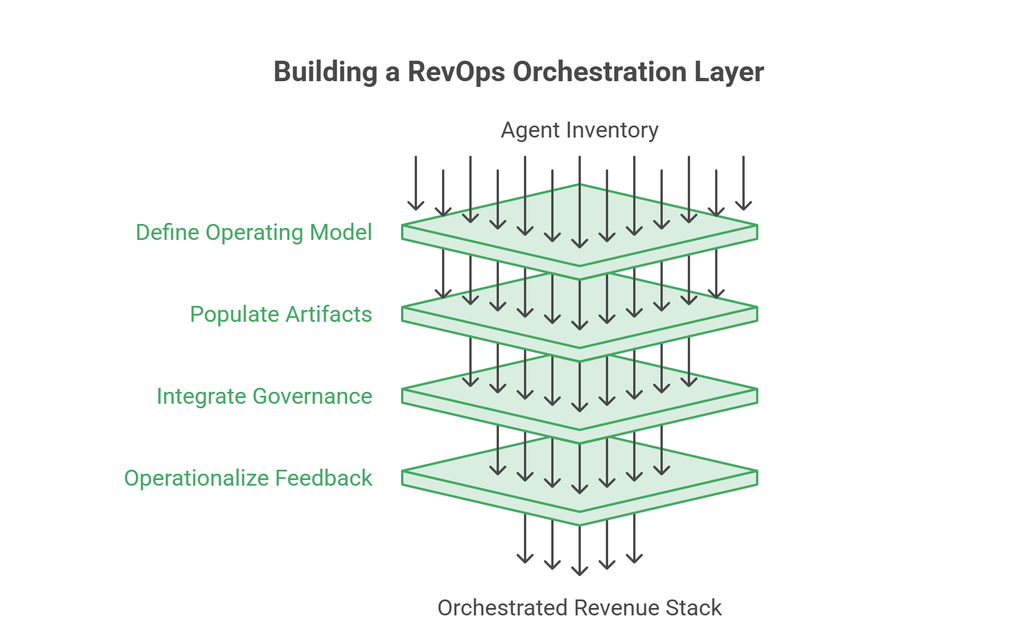
To build a RevOps orchestration layer, start with an inventory of the agents already operating against your revenue stack, even the ones nobody admits to deploying. The first step is to know what you have. From there, the build sequence is: define the operating model, populate the four artifacts, integrate them into the existing RevOps governance cadence, and operationalize the feedback loops.
The inventory itself is often the eye-opener. RevOps leaders who run the audit honestly almost always find more agents than they expected, deployed across more teams than they expected, against more parts of the revenue stack than they expected. The agent registry is the first artifact because it is the prerequisite for every other artifact. You cannot orchestrate what you cannot count.
After the registry, the hand-off matrix is usually the next priority because that is where coordination failures show up first. The governance and feedback layers follow. The full build typically takes one to two quarters for a mid-market organization and two to three quarters for an enterprise running multi-CRM environments, depending on how many agents the inventory surfaces.
What is the future of RevOps in the agentic era?
The future of RevOps in the agentic era is as the central orchestration function of the modern revenue organization, with strategic importance comparable to engineering or finance. The transition is already happening. The question is not whether RevOps owns the orchestration layer. The question is which RevOps leaders are positioning themselves to own it deliberately.
The RevOps leaders who are doing this well share a set of behaviors. They are running agent inventories before anyone asks them to. They are publishing the hand-off matrix as a coordination tool, not a compliance document. They are sitting in the conversations where new AI tools are being evaluated, with the framework that determines whether the tool fits the orchestration layer or fights it. They are positioning RevOps as the function the board talks to about AI, not the function IT routes AI questions to.
This is the strategic opportunity hiding inside the AI ROI crisis. The CROs who solve the AI problem will be promoted. The RevOps leaders who built the orchestration layer underneath them will be promoted with them. The function is being elevated. The leaders elevating it now will own the next decade of revenue architecture.
Join Us on July 9
The orchestration layer is not theoretical. It is the difference between AI that compounds and AI that stalls, and the conversation revenue leaders are having behind closed doors in 2026.
On July 9 at 2:00 PM EDT, Saqib Anjum walks through the five RevOps infrastructure gaps live, with a real enterprise diagnosis and the prioritization framework Mountainise uses to sequence the fix. The session covers how the orchestration layer sits on top of the data, governance, and feedback infrastructure that makes AI work, and how RevOps leaders are operationalizing it inside their organizations.
The session is built for VPs of RevOps, CROs, COOs, and CIOs who are formalizing AI orchestration ownership inside their organizations.