


TL;DR
In late 2023 we published a post about B2B lead generation as tending seeds. The metaphor was too soft. What we have learned across the RevOps engagements we have run since is that most B2B lead gen programs are not underperforming because of the channel or the content. They are underperforming because the CRM under them is broken, the ICP is unclear, and marketing and sales define a qualified lead differently on the same page. Add a buyer who now does most of the journey without ever speaking to a rep, and volume based lead gen becomes an expensive way to fill a broken funnel. This post is what we tell clients today, and what we would tell you if you booked the audit.
Key Takeaways
- Most B2B lead gen programs are not failing at the channel. They are failing at the CRM. MQL and SQL definitions differ between sales and marketing in roughly eight out of ten first audits we run.
- The 2023 playbook of “cast a wide net and nurture” costs more and converts less than it used to. Median B2B cost per lead crossed $200 in 2026 while median MQL to SQL conversion dropped into single digits.
- Buyers now do most of the journey alone. If your content is not machine readable and answer engine ready, you are invisible to the AI research your buyer is running before they ever fill out a form.
- Speed to lead matters more than most of the tactics on your quarterly plan. The teams we work with usually shave four to six hours off their response time in the first month of an engagement.
- Account based marketing is not a channel. Programs that treat it like one produce channel level results, not the returns the industry stats cite.
- Cost per SQL is the metric your board actually cares about. Cost per lead has been rewarding the wrong behavior for a decade.
- If your CRM data is more than 30 percent stale or duplicated, no lead gen tactic will fix your revenue problem. That is the plumbing conversation nobody wants to have and everybody needs to.
Introduction
Almost three years ago we wrote about B2B lead generation as if it were a garden that needed tending. It was a well meaning post. The metaphor was wrong. In the RevOps engagements we have run since, we have watched dozens of mid market B2B teams double their content output, triple their ad spend, and end the year with a smaller pipeline than they started with. That is not a garden problem. That is an infrastructure problem.
We get asked the same question in almost every discovery call: “Our lead volume is fine but revenue is flat. What are we missing?” The answer is rarely a new tactic. It is usually a broken definition of qualified, a CRM full of dead records, and a marketing team optimizing for MQL count while sales quietly ignores 70 percent of what marketing sends over. The channels have changed. The AI layer has changed. But the failure modes have not.
What follows is a plainer take on where B2B lead generation actually is in 2026, what has stopped working, and what the highest performing RevOps teams we work with do differently. We reference a handful of industry benchmarks for context, but the observations are ours. If you have already skimmed the fifteen “B2B lead gen statistics” posts that ranked ahead of this one, we hope this is more useful.
FAST FACT: Gartner’s 2026 sales survey found 67% of B2B buyers now prefer a rep free experience, up 17 percentage points from 2024. In our own client work, this shows up as prospects who arrive on the first sales call already knowing your pricing, your competitors, and the feature you shipped last quarter. Source: Gartner Press Release, March 2026.
Why the Playbook Stopped Working
Three things happened between our original post and today. Each one deserves less time in a keynote and more time in your ops meeting.
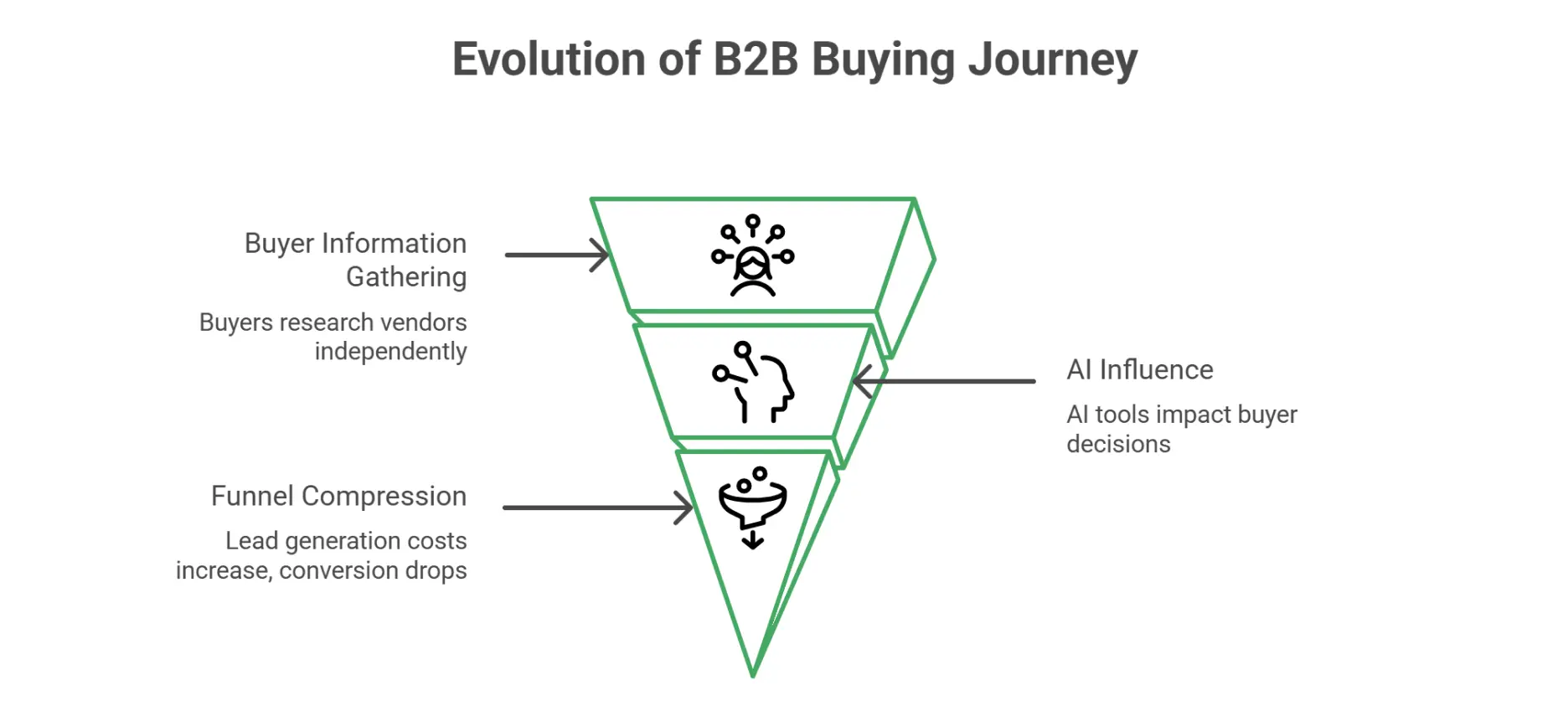
The buyer got quieter. Gartner puts roughly 80 percent of the B2B buying journey outside direct vendor contact today. In our client work this shows up in a specific way: prospects arrive on the demo call already knowing your pricing tiers, your top three competitors, and the feature you shipped last quarter. If your website was not the source of that information, someone else’s was. Or, increasingly, an AI was.
AI moved into the buyer’s chair. When a buyer asks ChatGPT or Claude to compare vendors, your marketing is either extracted correctly or misrepresented. We have watched two clients this year discover their own products misdescribed in AI answers because their site structure was hostile to extraction. The fix is not more content. It is clearer content, with FAQs, comparison tables, and explicit “we do this, we do not do this” positioning that a language model can parse without guessing.
The funnel compressed. Median B2B cost per lead crossed $200 in 2026 while median MQL to SQL conversion dropped into single digits, per HubSpot’s 2026 benchmarks compiled by DigitalApplied. Volume based lead gen used to be defensible when leads were cheap and conversion was steady. Both of those inputs changed. Most programs did not.
For the operating model behind how we rebuild programs for this environment, see our RevOps consulting practice.
The Metrics Your Board Is Actually Watching (And Why CPL Is Not One)
Cost per lead has been the KPI most B2B marketing teams optimize for. In our experience, it is the KPI most likely to make your revenue team unhappy with your marketing team.
The problem is not CPL as a number. The problem is that CPL rewards volume over fit. A team focused on CPL will always find channels that lower it. Those channels rarely produce revenue. Almost every audit we run catches the same pattern: the paid channels with the lowest CPL are also producing effectively zero closed won pipeline.
Here is what we push clients to report on instead. Cost per SQL aligns marketing spend with the pipeline it is supposed to feed and exposes channels that generate cheap leads no one buys from. Pipeline coverage ratio (qualified pipeline divided by quota) tells you whether your program is actually feeding the number. Three to four times coverage is a healthy quarter. Anything below two to one is a fire.
Speed to lead is the metric that punches above its weight. Data-Mania’s 2026 benchmarks put first hour follow up at 53 percent SQL conversion versus 17 percent past 24 hours. In our engagements we usually find speed to lead running four to six hours by default. Bringing it under an hour is often the highest ROI change we make in the first month, and it usually costs nothing but routing rules and one manager conversation.
Data hygiene is the metric nobody wants to look at. Deduplication rate, email verification rate, and completeness of ICP fields determine whether every other metric on this list is even accurate. Broken plumbing does not go away because you added a new channel.
If your dashboard only shows lead volume and CPL, you are giving your board the wrong signal. For teams on HubSpot or Salesforce, our Marketing Automation practice rebuilds the reporting layer.
Where Pipeline Actually Comes From in 2026
Every year a new channel wins the top of funnel award. Most of those wins do not survive contact with revenue attribution. Here is what we see actually producing pipeline for mid market B2B clients right now, in rough order of consistency.
LinkedIn, but only for the buying committee. Not because LinkedIn is a marketing genius. Because it is where your buyer’s professional attention actually is. Teams that treat LinkedIn as a broadcast channel get broadcast results. Teams that use it for identified, one to few outreach based on intent data get pipeline. The gap between those two approaches is enormous, and it is not about spend.
SEO for bottom of funnel content. Comparison pages, alternatives pages, pricing explainers, and “is X worth it” articles. The traffic volume is lower than top of funnel SEO. The conversion is much higher. Our clients running this play consistently see better MQL to SQL conversion from organic than from paid channels, and the compounding effect over twelve months makes the CAC math look very different than paid alone.
Webinars, but only if they are not a gated PDF in disguise. A live webinar with a specific promise, an operator giving a real answer, and a clear next step drives pipeline. A generic “future of X” panel does not. If your team cannot describe what a viewer will actually learn in one sentence, do not run it.
Multichannel outbound for target account outreach. Not cold email alone. Not cold call alone. Sequenced touches across email, LinkedIn, phone, and personalized landing pages, driven by intent data. Snov.io’s 2026 analysis puts multichannel CPL 31 percent below single channel. That matches what we see, though we would add that the delta on connect rate is usually larger than the delta on CPL.
Notice what is not on this list. Retargeting alone does not produce pipeline. It accelerates buyers who were going to buy anyway. Content syndication rarely produces qualified leads at mid market price points. Cold calling with no prior signal continues to work in some categories and continues to fail in most. For channel strategy tailored to your ICP, see our Digital Marketing practice.
Want a second opinion on your program?
Most of what we find in a two minute CRM audit surprises the person who ran the last pipeline review. If you want to see where your program sits against the 2026 benchmarks, and where the fixable problems are, start here. No sales call required to see the output.
Start Your Free RevOps AI CRM Audit →
ABM Is Not a Channel. Treating It Like One Is Why Your ABM Program Is Failing.
We have implemented account based marketing programs for a wide range of mid market and enterprise B2B clients. The pattern is consistent enough to state as a rule: the ABM programs that fail are the ones marketing runs by itself.
Real ABM requires three commitments that most first time programs skip. Sales and marketing agree on the target account list and, more importantly, on what engaged looks like account by account. The CRM enforces that agreement, including which reps own which accounts and how signal from marketing flows into rep queues. The reporting rolls up to account revenue, not campaign metrics.
When any of those pieces is missing, ABM turns into personalized ads to a list of logos. That version does not produce meaningful ROI, no matter what an industry stat says about the average.
The version that works produces the outsized returns aggregate ABM research keeps citing: mature programs routinely hit 5x to 9x ROI, larger deal sizes, and shorter cycles. In our engagements the biggest lift usually comes not from the ads or the outreach. It comes from finally aligning the target account list to the accounts sales was already trying to work.
If you are considering an ABM program, our Account Based Marketing practice runs the readiness assessment first. If your CRM cannot enforce account ownership and status, we tell you before you spend on ABM tooling. That is not a sales tactic. It is our Analysis-First methodology, and it has saved clients from spending on programs that would have failed.
What AI Actually Does For Lead Gen (Not the Hype Version)
Every RevOps consultancy in the market is claiming AI transformation right now. Most of what we actually deploy on client engagements is quieter than the marketing suggests.
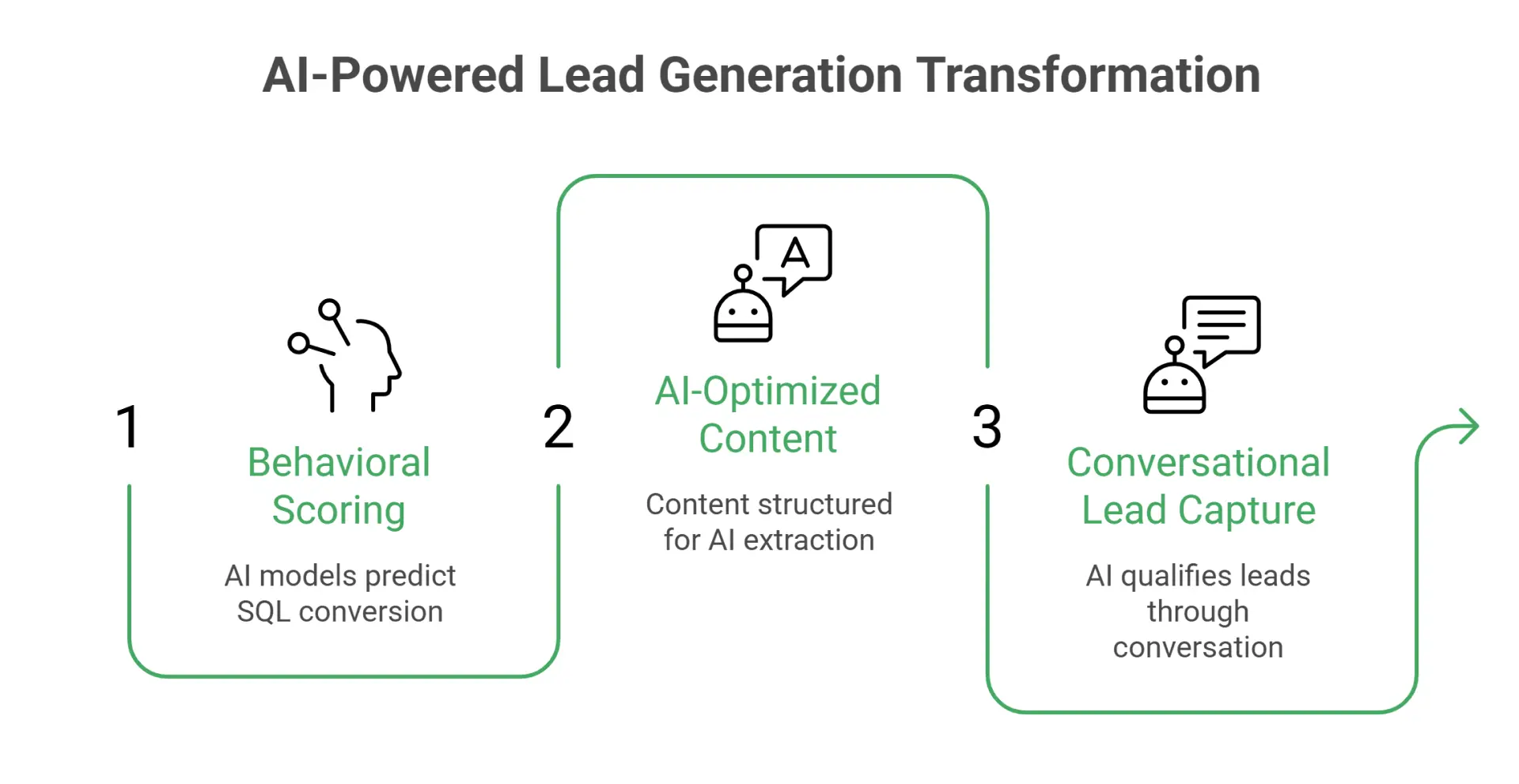
Better lead scoring. Behavioral scoring models produce meaningfully better MQL to SQL conversion than the demographic models most orgs still use. We have seen clients go from single digit conversion to the mid 20s within a quarter after replacing rules based scoring. This is not magic. It is the same predictive analytics that Salesforce Einstein and HubSpot Breeze have been shipping for years, finally tuned on real revenue outcomes rather than defaults.
Content structured for AI extraction. Buyers now research with AI. Content optimized only for Google is invisible to that layer. Per Apollo and Forrester’s 2026 research, 89 percent of B2B buyers use generative AI for self guided research. FAQ schema, comparison tables, explicit “we do this, we do not do this” statements, and clear pricing get extracted correctly. Fluff heavy corporate content does not.
Conversational lead capture. Our clients running this today are seeing measurable lift in qualified meeting bookings from the same traffic, because a real conversation qualifies better than a five field form.
What AI is not doing, at least in our experience: generating pipeline autonomously without oversight, replacing SDR judgment on complex objections, or accurately building forecasts without careful data prep. If your vendor is promising that, ask them for two named references with actual results. The reference conversations are usually more instructive than the sales pitch. For AI enabled lead gen strategy, our Agentic Marketing Solution team maps the roadmap.
The Sales-Marketing Disconnect Is a CRM Problem
We put this in almost every RevOps engagement kickoff: interpersonal problems between sales and marketing are usually symptoms. The cause is almost always in the CRM.
When sales says “these leads are terrible” and marketing says “sales does not follow up,” we start with three questions.
Are MQL and SQL defined the same way in both teams’ minds, and enforced by CRM fields? In roughly eight out of ten first audits we run, the answer is no. The definitions live in a Google Doc from 2022 and diverge from what the CRM actually scores.
Is there a service level agreement on response time, and is it enforced with alerts and escalations? Almost never. Sub hour response is aspirational, not systematized. Most orgs discover their real speed to lead only when we run the report.
Do sales and marketing share a single revenue number, or does each team have separate quotas? Most orgs have separate quotas. That produces separate incentives, which produces the exact disconnect that shows up in QBRs and quiet resentment in Slack.
Fixing this is not glamorous. It is CRM field enforcement, workflow automation, and reporting redesign. But it is the highest ROI change most B2B teams could make in 2026, and it costs less than any of the tactical experiments most orgs are running instead. Our CRM Implementation and Business Process Consultation practices rebuild these foundations.
If We Were Rebuilding Your Lead Gen Program Tomorrow
This is the question we get after most audits: if we started over from scratch, what would we do first? Here is the honest answer, in order.
Fix the CRM before anything else. Deduplicate the database. Populate ICP fields. Turn on workflow automation for lead assignment and status tracking. If the plumbing is not clean, every metric you look at later will lie to you.
Rewrite MQL and SQL definitions with sales in the room. Agree on the scoring criteria. Enforce it in fields. Turn off the vanity MQL alerts.
Set a sub hour response SLA and enforce it with routing rules and escalations. This is the single change that consistently produces the largest short term revenue lift in our engagements.
Pick two or three channels and go deep. For most mid market B2B this is LinkedIn (organic plus targeted paid), SEO for bottom of funnel content, and outbound to a curated target account list. Kill the rest for one quarter. See what changes.
Restructure reporting. Cost per SQL, pipeline coverage, speed to lead, and stage to stage conversion. Not lead volume. Not CPL. If your CFO cannot see revenue attribution in your dashboard, rebuild the dashboard.
Only then think about tactics: new content, ABM programs, AI tooling, new channels. Everything before those five foundational steps is throwing tactics at a broken system. This sequence is what our Lucrative RevOps Framework operationalizes for client engagements. It is not glamorous. It works.
Summary
If we had to distill what we have learned across the RevOps engagements we have run since our original 2023 post, it would be this: B2B lead generation in 2026 is not a channel problem or a content problem. It is an operational problem. Buyers self direct more of the journey, AI mediates more of the research, and the funnel converts less. Volume based tactics that worked in 2023 now waste budget and mask the real issue, which is usually a broken CRM, misaligned MQL definitions, and slow response times.
The teams outperforming their peers have stopped optimizing for lead volume and started optimizing for pipeline coverage, cost per SQL, and speed to lead. That shift is not glamorous. It usually requires rebuilding CRM enforcement, aligning sales and marketing on shared definitions, and killing the vanity metrics your board has been asking about for years. But it is what actually moves the number. If any of this sounds familiar and you want a second opinion, that is what we do.
Ready for a second opinion on your B2B lead gen program?
Mountainise is a San Francisco based RevOps consultancy, Salesforce Consulting Partner, and HubSpot Gold Solutions Partner. We run RevOps audits, CRM implementations, and lead generation program rebuilds for mid market and enterprise B2B teams. Our Analysis-First methodology and Lucrative RevOps Framework are how we deliver.
Book a Strategy Session with Mountainise →
Frequently Asked Questions
The blended B2B average sits around 13 percent, but Forrester’s 2026 data shows the median has fallen closer to 9.8 percent. SaaS averages higher, at 18 to 22 percent. Top performers using behavioral scoring reach 39 to 40 percent. If your rate is below 10 percent, we would look at three things before blaming the leads: your MQL definition, your response time, and your CRM data quality. Nine out of ten times, one of those three is the actual cause.
Not dead, but weakened. Cold calling still produces meetings in some categories, particularly regulated industries and legacy enterprise sales. In most tech B2B, our clients get better ROI from multichannel outbound driven by intent signals: warm outreach based on real buying behavior, not cold lists. The delta is not subtle. If you are still running cold call centric outbound and the numbers have been flat for two quarters, that is not a rep problem. That is a strategy problem.
The wrong question to start with. Before you allocate a budget, we would ask whether sales agrees with marketing on the target account list, and whether your CRM can enforce that alignment. If the answer to either is no, ABM tooling will not fix it. If yes, mature programs return 5x to 9x, but only after the alignment work is done first. We have seen more ABM budgets wasted on tooling before alignment than any other line item in RevOps.
Depends on scale and complexity. HubSpot works well for mid market up to about $25M ARR with a moderately complex sales motion, and its Breeze AI now covers most of what enterprise buyers assume they need Salesforce for. Salesforce becomes justified at higher revenue, multi product sales, or heavy custom object requirements. Both platforms can run modern lead gen if configured correctly. Both fail if not. Our HubSpot Revenue Engine practice covers HubSpot only builds. Our Salesforce practice covers Salesforce or hybrid environments.
Response time. If your team is following up on high intent inbound leads in more than an hour, cutting that to under 15 minutes with routing rules and escalations often lifts SQL conversion more than any tactic on your quarterly plan. It is boring, unsexy, and works. If we could only make one change on a client engagement, it would be this one.