



The term Fast Forward Deployment (FFD) has picked up massive popularity since 2025. When people hear it, they usually think of a specific concept: the deployment code must be built natively within that specific customer environment.
This definition has only gained more spotlight as companies like OpenAI have aggressively entered the fast forward space.
But as businesses, we need to differentiate our understanding of what Fast Forward actually means across different areas of the organization. FFD has vastly different implications, implementations, and outcomes depending on the need. It could be about developing a specific module, or it could be about retiring legacy technology systems to embrace the latest AI approaches.
However, if you think forward, there are three departments that always remain the soul of the organization: sales, marketing, and customer success.
Most systems built today, especially for product companies, are oriented around the product itself. They focus on the product features or the customer only in relation to that product.
The critical question is: how does Fast Forward Deployment act in these first three crucial areas? In short, how does Fast Forward Deployment apply to RevOps?
The Product vs. Solution Trap in RevOps
If we take a look at the current market, there are excellent examples of fast forward deployments, primarily impacting the top-to-mid funnel journey. Clay is a great example here. There are others, like Artisan.Ai.
But if you truly analyze these companies, they still offer a product.
This means your true gap in Fast Forward RevOps Deployment remains. You cannot solve this gap by convincing leadership to hire another agency to implement or optimize your CRMs, marketing automation, or data warehouses. That is maintenance, not Fast Forward RevOps Deployment.
True Fast Forward RevOps (FFRD) is something so powerful that most companies only imagine it, but rarely achieve the actual solution customized to their exact needs. This concept fits your unique sales and marketing model, not a generic template.
The Myth of the Static ICP and the Qualitative Failure
We know that defining an Ideal Customer Profile (ICP) is powerful. But we also need to understand that each ICP inside each business, even in the same industry, varies on so many fundamentals.
Consider this common scenario: you have one SDR closing 100 percent of their target, while another is only closing 40 percent. What does that mean? Is the tech piece failing? Is the leadership failing?
Let us not judge that too quickly. Let us put a realistic system in place to examine it.
According to our internal research of over 250 customers and their ops deployments over the last two years, we have come to a firm conclusion: Fast Forward RevOps Deployments are an essential piece of intelligence. They are not quantitative processes; they are part of the qualitative superiority of the organization.
To achieve that qualitative superiority, you take leadership thinking and bake it directly into the AI processes. This could be a very simple process. We must diligently avoid overcooking or overbaking every process through AI.
At the same time, you do not want to leave opportunities on the table. You want to make sure that whenever a process requires improvement, we take action.
The RevOps Diagnostic: Why You Need Surgery, Not Painkillers
The primary directive of Fast Forward RevOps is executing operations effectively without breaking the bank. You do not need massive additional technology expenses or to add millions of dollars in headcount and AI token spend.
You must look for small pieces, surgical additions to your current process, that make a significant difference.
Maybe it is changing a single line in your top-of-funnel messaging. It could be adding one additional qualification question to your sales process to completely change your lead quality. Or perhaps it is a single piece of sales intelligence that changes how your team approaches a deal.
To find these opportunities, you must look diligently beyond the obvious reporting. Your current teams and agencies are not programmed to find these deeper leaks.
Consider this diagnostic example we encountered: We had a large client sending significant, valuable email outreach. A massive amount of revenue was driven by these efforts.
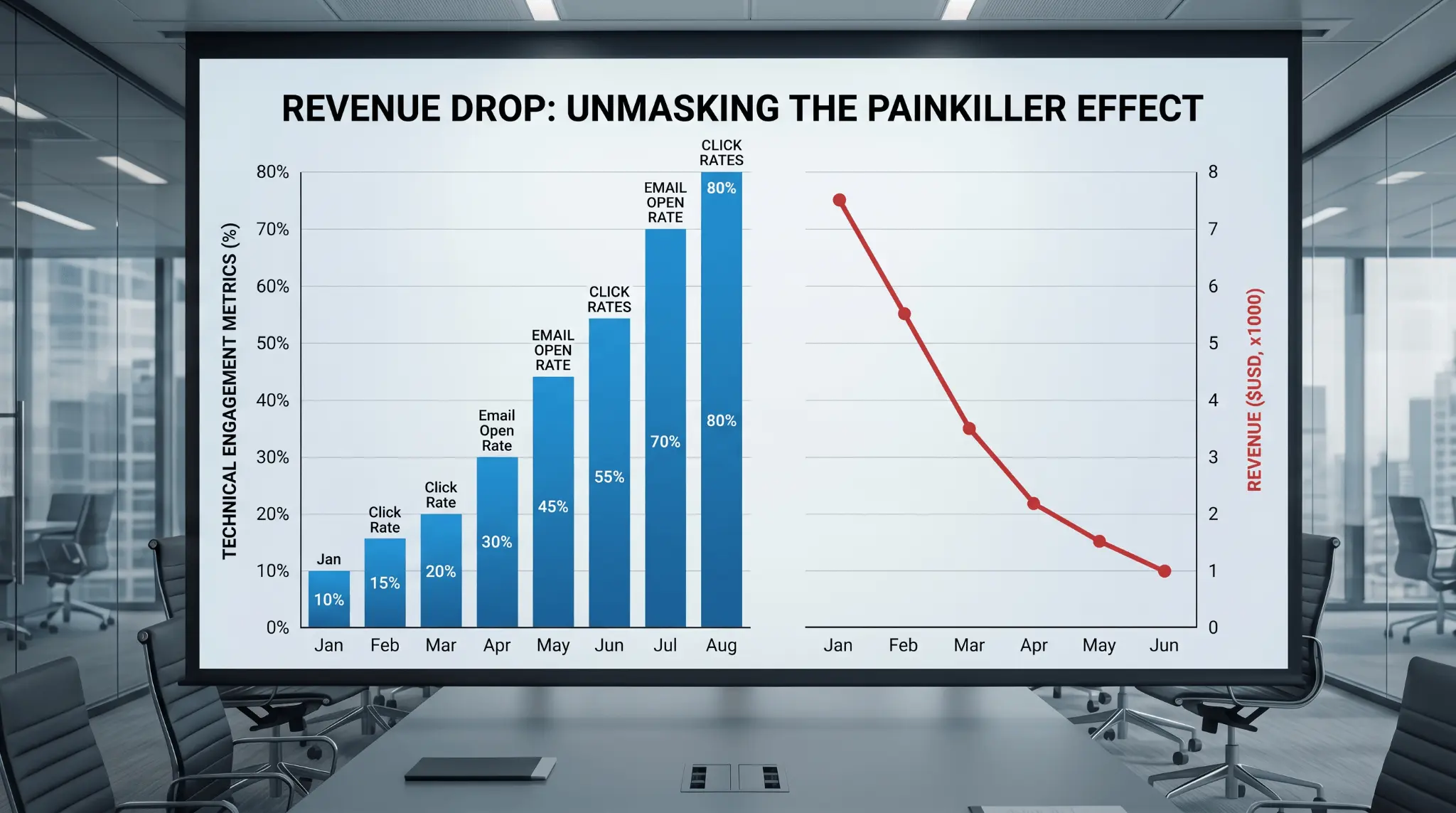
Suddenly, the effectiveness of the technology seemed to burn out. Revenue dropped with no obvious reason. When the client looked at the stats, everything seemed identical to their successful past: open rates were higher, and click-through rates were stronger than ever.
Yet, the sales team was screaming because nobody was actually appearing for the appointments.
This is exactly where Fast Forward RevOps Deployment looks differently. A standard agency or internal team reports on the technical system working. They see high engagement metrics. FFRD tries to find the leakage beyond that simple thinking.
The same sales team, given different diagnostic numbers, had to dissect their entire process. We discovered the underlying conditions had changed. Your obvious assumption (good stats = good performance) goes wild when you realize the underlying conditions are different.
It is just like the way you keep getting painkillers for a headache. The painkiller works on the symptom. But technically, there is stage three cancer going on. Standard metrics are the painkillers; they mask the real issue.
The Mountainise Approach to Fast Forward RevOps
This level of diagnostic in Fast Forward RevOps Deployments is crucial. This is why you need the expertise of companies that have seen failures before. This failure-based experience allows them to come in and surgically place the correct AI process into the system.
We strongly want you to avoid thinking that you need massive AI agents and excessive “agent stunning” before you can truly imagine the reason for a failure.
This is how Mountainise has built intensive, year-over-year experience. By gaining this depth with our customers, we are now able to think and go deeper into the diagnostic. We don’t just solve problems; we find the unobvious leaks that others ignore.